


Introduction: The Death of the Interface
For four decades, humans and computers interacted through the “User Interface” (UI). From the command line of the 80s to the graphical icons of the 90s and the touchscreens of the 2010s, the method was consistent: a person had to click, type, or swipe to make a machine complete a task.
By 2026, we entered the era of Zero-UI and Agentic AI and Multiagent Systems We now interact with technology based on intent rather than through menus. We simply set a high-level goal, and a group of autonomous agents, referred to as the “Silicon Workforce,” manages the details of how to achieve it. We have shifted from Generative AI—which creates content—to Agentic AI, which produces results.
This change has gone beyond innovation labs. It has become structural. By the beginning of 2026, more than 40% of enterprise workflows involve autonomous AI agents. Organizations are not just adding AI; they are restructuring their entire operating models to make it a core part.
Agentic AI and Multiagent Systems
Part I: The Anatomy of an AI Agent
To understand this workforce, we need to first grasp what an AI agent is. An AI Agent is more than just a Large Language Model (LLM); it is an LLM equipped with tools for action and reasoning equipment.
1.1 The Cognitive Loop: ReAct and Beyond
In 2026, agents operate on advanced reasoning systems known as ReAct (Reason + Act). Traditional AI followed a “straight line” (Prompt to Answer). Agentic AI operates in a “loop.”
When an agent is assigned a task like “Optimizing the Q3 supply chain,” it follows a recursive process:
- Reasoning: It evaluates the goal and identifies missing information (for example, “I need current shipping rates from the South China Sea”).
- Acting: It calls an API or uses a web-browser tool to gather live data.
- Observation: It notices that rates have increased by 20% due to regional instability.
- Correction: It alters its plan to consider rail alternatives or local suppliers, instead of continuing with the original sea freight plan.
1.2 Memory Systems: RAG vs. Long-Term Context
In 2026, agents use Retrieval-Augmented Generation (RAG) for more than just facts; they also use it for identity. An agent remembers specific details about a company’s voice, past mistakes, and legal guidelines. This “episodic memory” enables an agent to learn from a mistake made recently, similar to how a human employee would. The focus in 2026 has shifted from “building larger models” to “building better memory.”
Part II: Multi-Agent Systems (MAS) – The Digital Org Chart
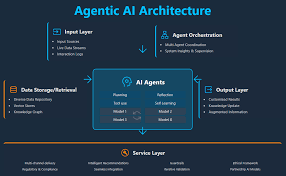
While a single agent is powerful, the real change lies in Multi-Agent Systems (MAS). In 2026, complex enterprise tasks are seldom managed by a single “god-model.” Instead, they are divided into a hierarchy of specialized agents.
2.1 The Logic of Specialization
Why use five agents instead of one?
- Reduced Hallucination: A specialized “Reviewer Agent” is statistically more likely to catch errors in a “Coder Agent’s” work than the Coder Agent is to catch its own mistakes.
- Computational Efficiency: Small, specialized models (like 7B or 14B parameter models) are cheaper and faster for specific tasks than a large 1 trillion+ parameter general model.
- Conflict Resolution: Different tasks need different “personalities.” A customer support agent requires empathy; a code review agent must be critical and structured. Combining these into one model leads to “context pollution,” while separate agents excel.
2.2 Orchestration Patterns
In 2026, we observe three main MAS structures:
- The Manager-Worker Pattern: A central “Orchestrator” agent receives the goal, assigns sub-tasks to worker agents, and compiles the final report.
- The Peer-to-Peer Pattern: Agents communicate in a shared digital space (a “blackboard”), and any agent with the right skills picks up the task.
- The Red-Blue Pattern: One agent proposes a solution, while another looks for vulnerabilities or flaws in it, ensuring high-quality outputs.
Part III: The Silicon Workforce in Practice (2026 Case Studies)
3.1 Procurement: The Autonomous Buyer
Procurement has changed from reactive ticket-filling to proactive category management.
- The Sourcing Agent: Joule’s Sourcing Agent and Inception’s Procurement Assistant have become industry standards. They not only locate suppliers but also assess them based on real-time risk, labor compliance, and past performance.
- Real-Time Visibility: Agents offer a “control tower” view of spending, automatically flagging invoice discrepancies and creating credit memos without assistance.
3.2 Human Resources: The Lifecycle Agent
HR agents have shortened inquiry resolution time by up to 80% in companies like AMD.
- Recruitment: Voice agents now conduct natural screening conversations, cutting screening time from days to hours.
- Employee Experience: From “welcome kits” to complex benefits questions, agents gather context from Slack threads, wikis, and policy documents to provide personalized, 24/7 support.
3.3 IT and Cybersecurity: The Self-Healing Grid
IT has moved from “Help Desk” to “Autonomous Infrastructure.”
- Auto-Resolution: AI agents now resolve IT service tickets automatically and reroute supplies to address inventory shortages without human intervention.
- Cyber Defense: Cybersecurity has turned into an “AI-versus-AI” battleground. Self-repairing digital immune systems spot irregularities and apply patches in milliseconds, much quicker than any human “Red Team” could respond.
Part IV: The Economic Shift – Usage and Outcome-Based Pricing
The Silicon Workforce has undermined the “Seat-Based” SaaS model. In 2026, charging “per login” no longer makes sense if an AI agent completes the work.
4.1 Five Dominant Pricing Models of 2026
- Outcome-Based Pricing: You pay for results—such as meetings booked, tickets resolved, or fraud prevented. This ties the vendor’s revenue directly to the customer’s success.
- Action/Workflow-Based: Charging per “instance of work done” (like $2 per conversation or $0.99 per resolution).
- Per-Agent “Seats”: Treating agents as digital employees with a monthly fee (typically $29 to $500/month).
- Credit-Based Systems: Pre-purchased credits that “burn” at different rates based on task complexity.
- Hybrid Models: A steady base fee combined with a variable usage component. This is now the market standard, providing budget predictability alongside vendor cost recovery.
4.2 The Inference Economy
By 2026, inference (running the AI) makes up 70-80% of total AI computing costs. This is why pricing must be flexible. As infrastructure costs drop, pricing strategies are evolving to capture value through results instead of mere consumption of tokens.
Part V: Challenges and the “Human-in-the-Loop”
We do not live in a world of complete machine autonomy. The “Silicon Workforce” still needs a “Carbon Manager.”
5.1 The Alignment and Trust Gap
While agentic AI can speed up processes by 30-50%, concerns over inaccurate data and “loop-de-loops” (where agents get stuck in repetitive logic) persist.
- The Solution: Virtual “Control Towers” monitor every deployed agent, assigning a human “owner” to each one. For instance, a retail manager may oversee an AI agent but must manually approve any refund over $500.
5.2 The Skill Change Index
McKinsey’s 2026 data shows that although 70% of human skills still matter, they are applied differently. We now spend less time on “basic research” and more time on “framing the question” and “interpreting the result.” The essential skill in 2026 is AI Fluency—the ability to manage and coordinate these digital teams.
Part VI: Implementing the Silicon Workforce (A 2026 Roadmap)
For companies planning to move from “Chatbots” to “Agents,” the transition involves three steps:
- Identify “Agent-Ready” Areas: Look for repetitive, data-rich, and cross-functional workflows (like invoice processing or dispute resolution).
- Platform Re-Architecture: Shift from static APIs to event-driven infrastructure. Use the Model Context Protocol (MCP) to enable agents to securely access various data sources.
- Governance First: Establish role-based access controls for agents. An agent should be treated like a new hire—given only the permissions and “sandbox” access necessary to perform its role.
Conclusion: The New Productivity Frontier
The shift from chatbots to agentic systems marks the most significant advancement in productivity since the industrial revolution. We are no longer restricted by how many people we can hire but by how much computing power we can manage effectively.
The Silicon Workforce is not here to take our jobs; it is designed to carry out the “drudgery of logic,” allowing humans to focus on the “nuance of strategy.” As we progress through 2026, the important question is not “What can AI say?” but “What can your AI agents achieve today?”
The Future of Your Workforce
2023: We interacted with AI (The Chatbot Era).
2024: AI assisted us in writing (The Copilot Era).
2025: AI began to take actions (The Agent Era).
2026: AI manages workflows, while humans manage outcomes (The Silicon Workforce Era).Read more…