


We are witnessing the last days of screens as the main way we interact with technology. For years, we have thought of artificial intelligence as a tool—a chatbot we prompt, an app we open, or a generator we feed with instructions. But as we move through 2026, that era has come to an end. We are no longer using AI we use Ambient AI Invisible Intelligence; we are living with it.
This marks the rise of Ambient AI, often called Invisible Intelligence. Our reality now has a central nervous system. AI has blended into our surroundings—walls, furniture, streets, and even clothing. It is no longer an outside force; it has become the “digital oxygen” that simplifies our lives. Yet, this comfort brings a deep psychological cost: the steady, low-grade anxiety of living inside a machine that anticipates our actions.
The Death of the Interface: From Clicking to Existing
The biggest change in 2026 is the complete disappearance of the “prompt.” In the past, we had to learn the right keywords and click the correct buttons to interact with machines. Ambient AI eliminates this need entirely. It relies on a vast network of nanosensors and high-quality microphones that process data right in the room with us, not in a faraway data center.
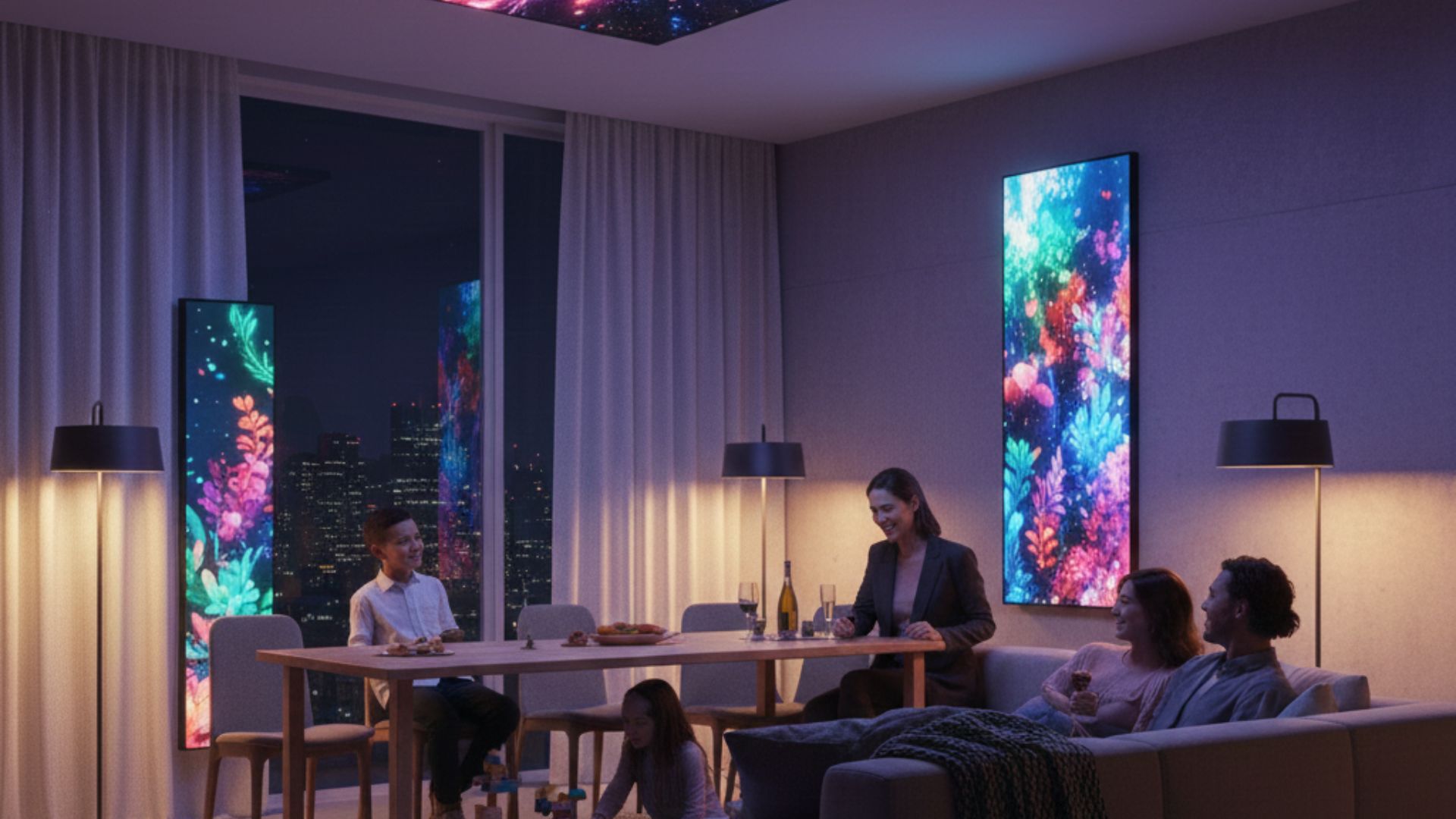
When you return home, the environment doesn’t wait for you to say, “turn on the lights.” It recognizes your movements, heart rate, and even the tiny dilation of your pupils. If it senses that you’re stressed from a long day, the lighting doesn’t just brighten; it shifts to a warm frequency specifically designed to lower cortisol levels. The music doesn’t just start; it picks a tempo that matches your breathing to help you relax.
This signifies a shift from Reactive AI to Proactive Intelligence. The environment now acts as an intuitive assistant, working quietly in the background. It is helpful, efficient, and completely silent.
The “Silent Scribe” and the Transformation of Professional Life
This invisible revolution is most evident in the medical and professional sectors in 2026. For years, doctors and lawyers complained about the “administrative burden” of typing notes, filling charts, and recording every detail.
Ambient AI has relieved us of this burden. In modern clinics, the doctor simply talks with the patient. There are no keyboards in sight. Invisible “scribes” listen to the conversation, using advanced natural language processing to distinguish casual chatter from clinical data. The AI identifies symptoms, notes the patient’s history, and automatically creates a structured medical record ready for review the moment the appointment ends.
In the corporate world, the “Smart Office” has become a dynamic entity. Conference rooms now sense the “energy” of a meeting. If the AI notices a drop in engagement based on speech patterns, it can subtly adjust the temperature or oxygen levels to enhance alertness, or quietly display relevant information on a wall that fills in gaps in the discussion.
The Nervous System of the Smart City
As we step outside of homes and offices, Ambient AI’s scale becomes impressive. Cities in 2026 are governed by Dynamic Infrastructure. Streetlights are now complex nodes in a city system, not just bulbs on timers.
These nodes use radar and thermal imaging to monitor the city’s activity. They regulate traffic flow in real time by anticipating movements of vehicles and pedestrians. If a child runs into the street three blocks away, nearby cars receive a signal to slow down before drivers even notice the danger.
Waste management, energy distribution, and emergency responses are all managed by this invisible layer. If a water pipe starts to vibrate in a way that suggests it might burst, a repair drone is dispatched before any water is lost. The city operates on its own, continuously improving and self-sustaining. For most citizens, it simply “works,” but countless data points are processed every second to create that impression of effortless order.
Ambient AI Invisible Intelligence :

The Anxiety of the Always-On World
Yet, this seamless life has given birth to a new psychological issue: Ambient Anxiety. When AI goes unnoticed, it becomes hard to tell where surveillance ends. In 2026, we must face the fact that our “private” moments may be used to train our environments.
If your “smart” mattress knows you had a restless night, and your “smart” coffee maker offers an extra shot of caffeine, and your “smart” car suggests a slower route because it knows your reflexes are sluggish—you are receiving care, but you are also under scrutiny. Every movement is a data point. Every sigh is a signal.
There is a growing concern that we are losing the “right to be unconventional” or the “right to be inefficient.” If our world is completely optimized for our productivity and health, is there any space for the messy and spontaneous sides of being human? Many people in 2026 are now looking for “Dead Zones”—places where sensors are not allowed—just to feel truly alone and unmonitored.
The Technical Backbone: Why Now?
This shift didn’t occur in 2023 or 2024 due to the “latency gap” and “power needs.” Traditional AI used too much energy and took too long to process because data had to travel to the cloud and back.
The breakthroughs in 2026 are two specific technologies:
Neuromorphic Computing: These chips work like biological brains. They use almost no power when not processing data, allowing them to be embedded in everything from wallpaper to clothing.
Edge Intelligence: By placing the “brain” in the sensor itself, the environment can react quickly. This speed makes AI feel like instinct rather than software.
This combined approach means the environment’s “reflexes” are local and private, while the “wisdom” from long-term learning comes from larger, distributed networks.
The Tipping Point of Human Agency
As we look to the future, the key question of the Ambient AI era centers on autonomy. When the environment makes every small decision for us—from the shower temperature to email priorities—do we eventually lose the ability to choose for ourselves?
We are entering a time when the “self” expands to include the digital space around us. Our “intuition” is now supported by a global network of invisible intelligence. We enjoy unprecedented comfort, safety, and efficiency. Yet, as the interface disappears and AI becomes part of the background, we must remain aware.
The most important task in a world of Invisible Intelligence is to remember that just because you can’t see the machine doesn’t mean you aren’t living within it. The challenge for this decade will be to appreciate the quiet of Ambient AI without forgetting how to express ourselves.Read more..