


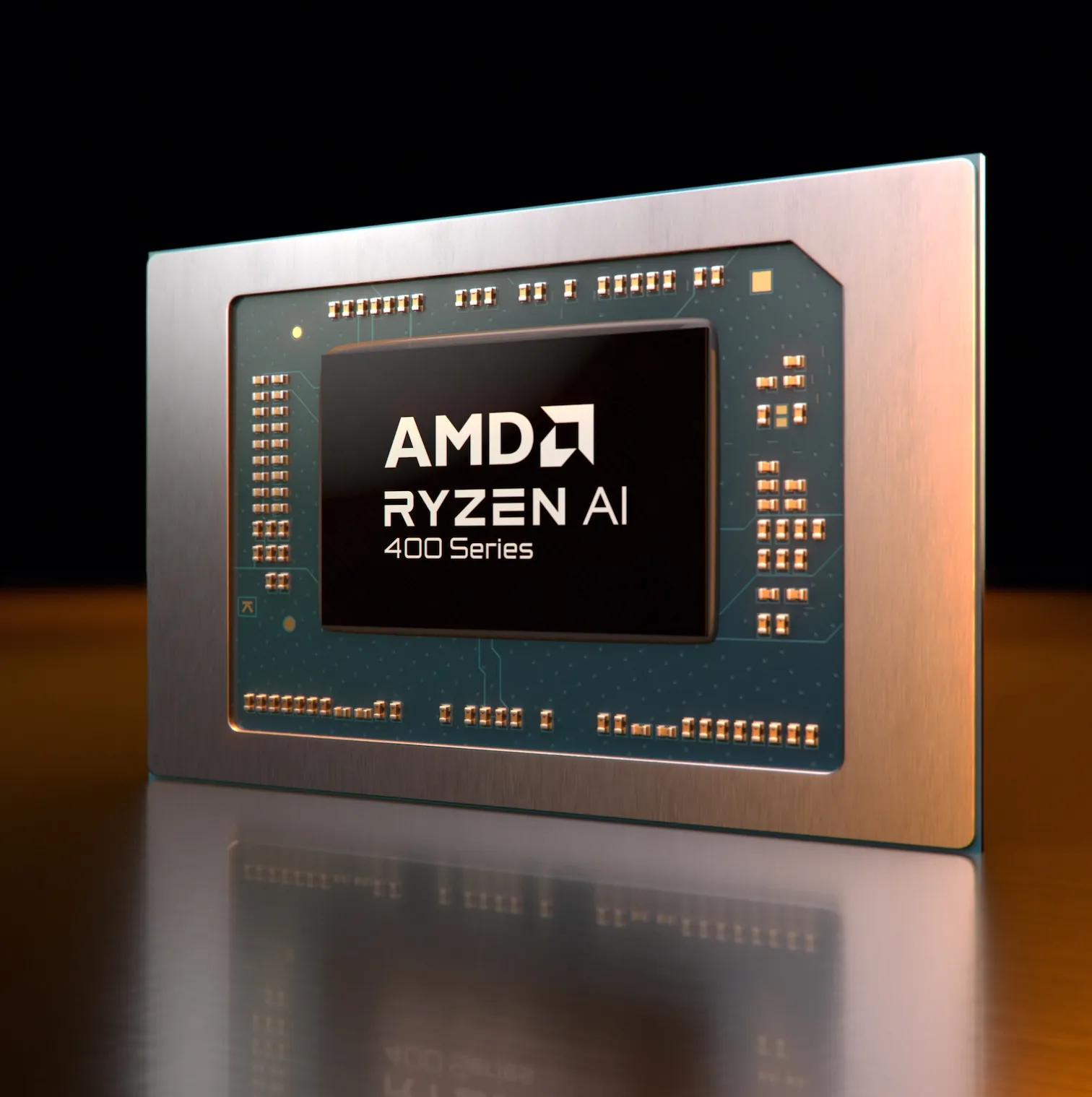
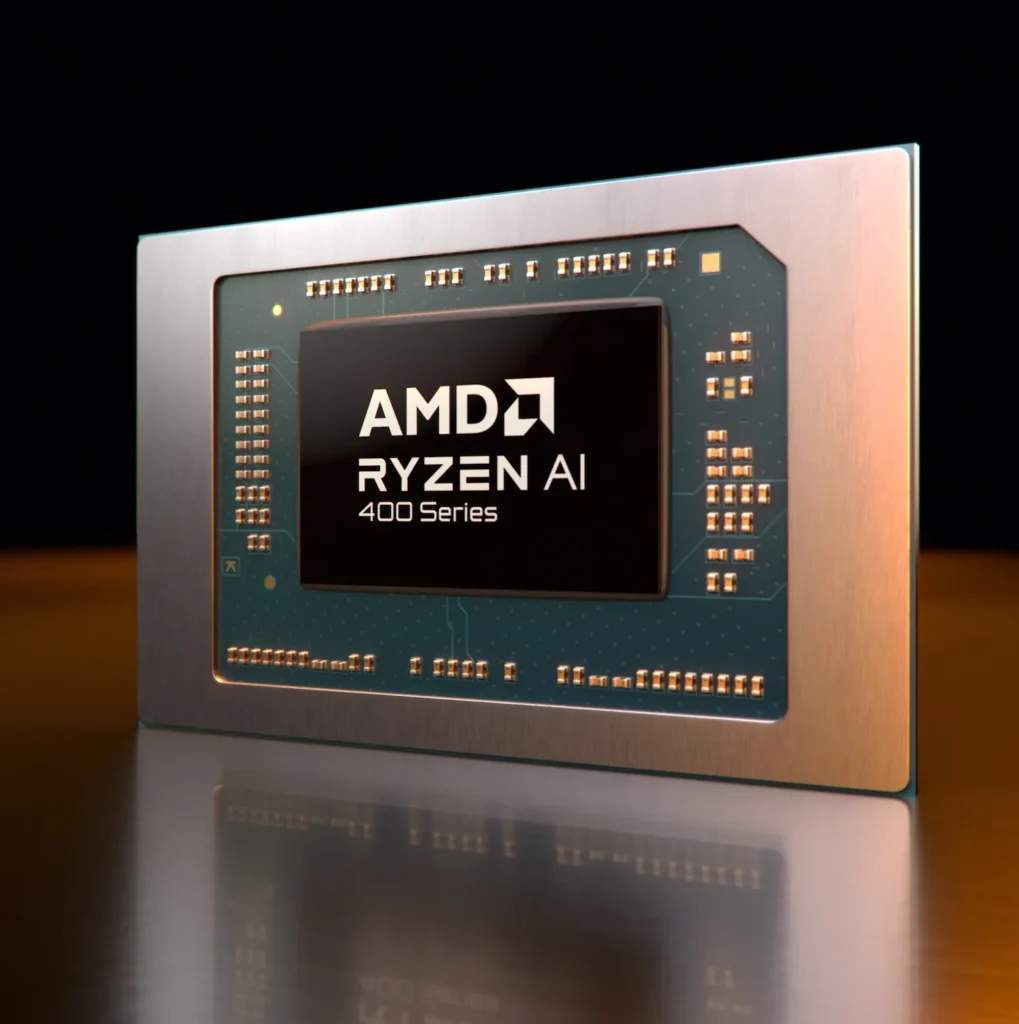
The story of personal computing changed on January 5, 2026, at the AMD keynote in Las Vegas. Dr. Lisa Su unveiled the AMD Ryzen AI 400 Series, codenamed “Gorgon Point.”
This launch marks a crucial moment for x86 architecture. It shows that “AI” has moved from a marketing term to real, high-performance technology. With 60 TOPS of dedicated NPU performance, the Zen 5 core architecture, and the arrival of RDNA 3.5 integrated graphics, AMD has raised the bar, prompting competitors like Intel and Qualcomm to rethink their 2026 plans.
- The Silicon Foundation: Deep Dive into Zen 5 and Gorgon Point
The Ryzen AI 400 series is built on the Zen 5 architecture. Unlike previous versions that prioritized clock speed, Zen 5 focuses on Instruction-per-Clock (IPC) efficiency and better power management.
The Architecture of Zen 5
Zen 5 is made using TSMC’s 4nm FinFET process and brings several significant design changes:
- Wider Dispatch: The instruction fetch and dispatch width has increased, enabling the CPU to manage more tasks at once each cycle.
- Dual-Pipe AVX-512: Mobile Zen cores now feature a full 512-bit data path without the frequency penalties of older designs. This is essential for scientific workloads and local AI tasks that don’t use the NPU.
- Cache Re-engineering: The L1 and L2 cache paths are wider, which lowers latency and ensures that the “Gorgon Point” dies can supply data to the cores as quickly as the memory allows.Read more…..
Hybrid Core Management
AMD’s “Strix” design uses a mix of Zen 5 and Zen 5c cores.
- Zen 5 (Performance): These cores are larger and can reach higher clock speeds (up to 5.2GHz). They handle main tasks like gaming and 4K video editing.
- Zen 5c (Efficiency): These cores share the same Instruction Set Architecture (ISA) but are more compact. They manage background AI tasks—like organizing files, real-time translation, and system security—while using less power.
AMD Ryzen AI 400 Series:
- XDNA 2: The 60 TOPS Neural Powerhouse
While the CPU tackles “logic,” the XDNA 2 NPU manages “intuition.” This spatial-array design includes hundreds of AIE (AI Engine) tiles.
Shattering the 40 TOPS Requirement
Microsoft’s Copilot+ PC initiative needs 40 TOPS. AMD exceeded this, reaching 60 TOPS, surpassing the requirement by 50%.
- BFP16 Support: XDNA 2 adds Block Floating Point 16, providing the precision of 16-bit floats while maintaining the efficiency of 8-bit integers. This is key for making real-time voice translation sound natural.
- Zero-Latency Context Switching: The NPU can quickly switch between different AI models (like moving from text summarization to image generation) in milliseconds, eliminating the “UI lag” often found in early AI PCs.
- Integrated Graphics: RDNA 3.5 and FSR Redstone
The Radeon 890M, included in the top-end Ryzen AI 400 chips, is like a mid-range desktop GPU miniaturized for laptops.
The RDNA 3.5 Advantage
RDNA 3.5 optimizes the architecture used in the RX 7000 series, making it suitable for memory-limited setups.
- 16 Compute Units (CUs): At 3.1 GHz, the Radeon 890M outperforms some entry-level discrete GPUs, such as the RTX 3050 Laptop, in raw rasterization.
- FSR Redstone (AI Upscaling): This is AMD’s response to DLSS. Unlike earlier versions, Redstone employs the NPU for spatial and temporal reconstruction. This lets a game running at 720p look like it’s at 1440p, maintaining over 60 FPS on lightweight laptops.
- The 2026 Product Stack: Detailed Specifications
| Model | Architecture | Cores (P/E) | NPU TOPS | Graphics | TDP Range |
|---|---|---|---|---|---|
| Ryzen AI 9 HX 475 | Zen 512 | (4/8) | 60 | Radeon 890M | 15W – 54W |
| Ryzen AI 9 HX 470 | Zen 512 | (4/8) | 55 | Radeon 890M | 15W – 54W |
| Ryzen AI 9 465 | Zen 510 | (4/6) | 50 | Radeon 880M | 15W – 45W |
| Ryzen AI 7 450 | Zen 58 | (2/6) | 50 | Radeon 860M | 15W – 35W |
| Ryzen AI 5 435 | Zen 56 | (2/4) | 50 | Radeon 840M | 15W – 28W |
- Real-World Benchmarking: AMD vs. The World
In internal tests and leaked “Cinebench R26” results, the Ryzen AI 9 HX 475 leads in key areas:
- Multithreaded Performance: With its 12-core Zen 5 setup, the HX 475 scores 1.4 times higher than the Intel Core Ultra 7 (Lunar Lake) for heavy multithreaded tasks. This makes it ideal for mobile architects and video editors.
- AI Inference (Procyon AI): In the UL Procyon AI benchmark, the XDNA 2 NPU scores 35% higher than the Snapdragon X Elite. This leads to notably faster responses when using local LLMs (Large Language Models) like Llama 3.
- Enterprise and Security: The AMD PRO Advantage
For businesses, the Ryzen AI 400 Series features AMD PRO Technologies.
- AMD Memory Guard: Full memory encryption protects against cold-boot attacks.
- Microsoft Pluton Integration: This is a chip-to-cloud security technology that safeguards credentials, user identities, and encryption keys.
- AI-Enhanced Manageability: IT managers can use the NPU to run local security agents that detect malware patterns in real-time without slowing user workflows.
- OEM Showcase: The First Wave of Ryzen AI 400 Laptops
ASUS Zenbook S 16 (2026)
This launch’s flagship features a “Ceraluminum” chassis.
- Processor: Ryzen AI 9 HX 475.
- Display: 16″ 3K 120Hz OLED.
- Battery: Up to 25 hours of productivity.
HP OmniBook Ultra 14
A premium laptop for business users.
- AI Feature: HP “AI Companion” uses the 60 TOPS NPU to automate meeting notes and secure local file indexing.
- Connectivity: Wi-Fi 7 and 5G ready.
Lenovo Yoga Slim 7x Gen 2
Designed for “AI-First” creators.
- Cooling: A new dual-fan vapor chamber design helps the HX 475 maintain a sustained 45W boost for longer rendering tasks.
- The Software Ecosystem: ROCm 7.2 and The AI Bundle
AMD is bridging the software gap with ROCm 7.2 for Windows. Developers can use this same software stack for mobile laptops as they do for high-end Instinct AI accelerators in data centers.
- The AI Bundle: New laptops will come with a suite of local AI tools pre-installed, including a private document assistant and an AI-powered photo editor that doesn’t need a subscription.
Conclusion: Why the Ryzen AI 400 Series Wins
The AMD Ryzen AI 400 Series is the best processor of 2026. While Intel performs well in density and Qualcomm excels in battery life, AMD offers a complete solution:
- Top-tier gaming on integrated graphics.
- Unmatched multithreaded performance for professionals.
- Industry-leading 60 TOPS NPU for the next five years of AI software.
The Era of the Autonomous PC is here, and it runs on AMD.