

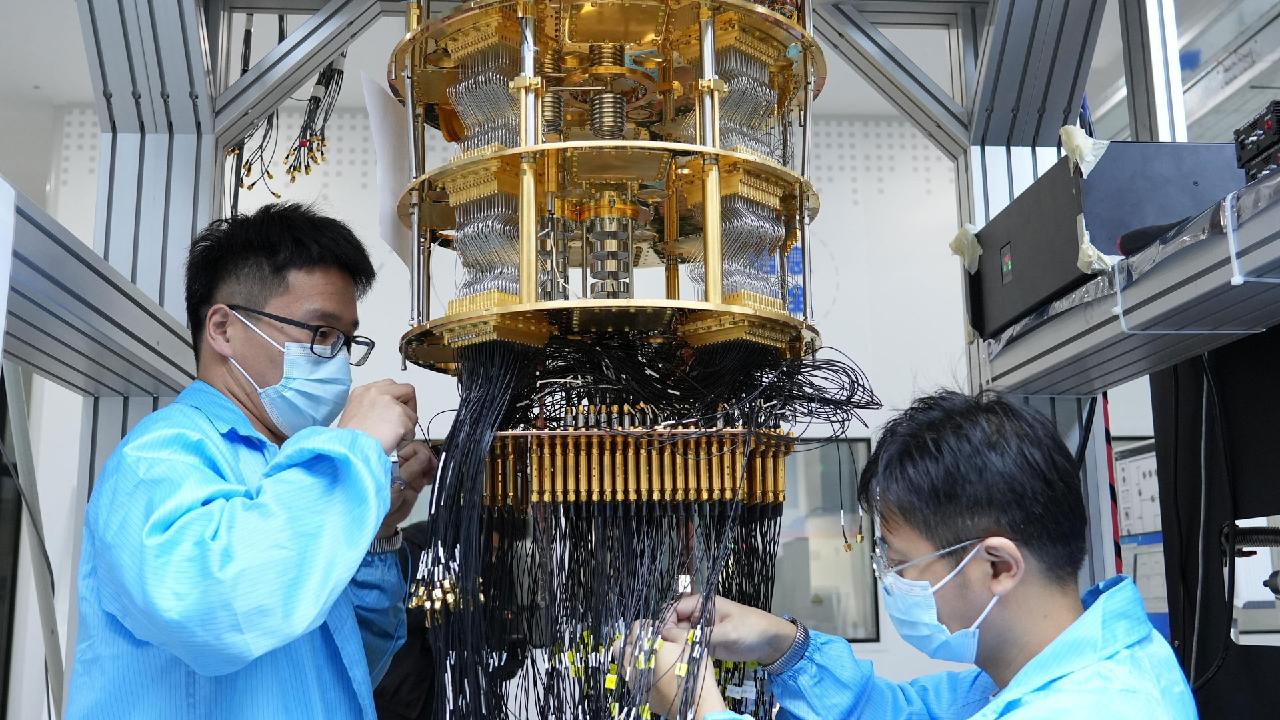
The global tech landscape has reached a significant turning point. For decades, the silicon chip has been the primary driver of progress. However, as we move through 2026, we face the physical limits of classical materials, leading to a change. Recent reports from the China Briefing and the University of Science and Technology of China (USTC) confirm that we have transitioned from theoretical physics into the realm of China Quantum Superiority 2026.
Quantum superiority is more than just a faster version of what we already have; it fundamentally changes how we process information. Classical computers use bits (0s and 1s), while quantum computers use qubits, taking advantage of the unusual behaviors of subatomic particles to perform calculations in a multidimensional space.
The Dual-Engine Strategy: Superconducting vs. Photonic
China’s emergence in the quantum field results from a focused, two-pronged strategy to tackle challenging engineering problems. While Western companies like IBM and Google concentrate on superconducting circuits, Chinese researchers excel in both superconducting and optical (photonic) architectures. This ensures that if one approach faces setbacks, the other can advance.
- The Superconducting Powerhouse: Zuchongzhi 3.0
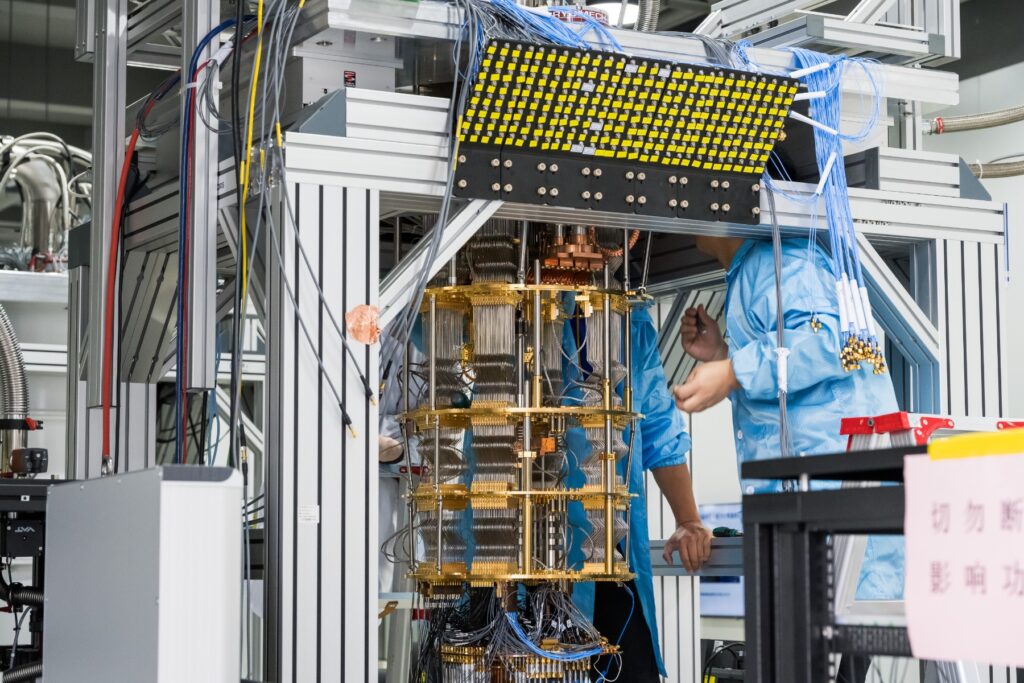
Superconducting qubits represent the “heavy metal” of the quantum realm. They consist of tiny circuits made from materials like niobium or aluminum, cooled to 10 millikelvin (colder than outer space). At these temperatures, electricity flows without resistance, enabling the circuits to function as “artificial atoms.”
- The Scaling Breakthrough: As of 2026, the Zuchongzhi series has surpassed 200 qubits. In quantum computing, adding one qubit does not just slightly increase power; it doubles the computational capacity. A 200-qubit machine can represent more simultaneous states than there are grains of sand on Earth.
- Active Error Correction: The main challenge for superconductors has always been “noise”—vibrations or heat that can disrupt the quantum state (decoherence). The latest Chinese systems have integrated surface-code error correction, allowing the machine to detect and correct its errors during calculations without interrupting the process.
- The Light-Speed Disruptor: Jiuzhang 3.0 (Photonic)
If superconducting computers are the “engines,” photonic computers are the “light beams.” Photonic quantum computing uses light particles (photons) instead of electrons.
- The Jiuzhang Milestone: Recently, the Jiuzhang 3.0 system achieved a speed improvement that is hard to imagine. In a task called Gaussian Boson Sampling (GBS), which tracks how photons interact in a complex arrangement of mirrors, it finished a calculation in about one microsecond.
- The Classical Comparison: To achieve what Jiuzhang did in one microsecond, the Frontier supercomputer (one of the fastest worldwide) would need to operate for over 30 billion years. This isn’t just a competitive edge; it separates itself entirely from classical capabilities.
- The Practical Advantage: Unlike superconductors, photons do not interact strongly with their environment. This means photonic chips can eventually run at much higher temperatures, eliminating the need for huge, costly cooling systems.
The “Sputnik Moment” in Mathematics and Cryptography
The China Briefing highlights these achievements because “Quantum Superiority” could break the codes that protect our modern world.
The End of RSA Encryption
Modern cybersecurity relies on the difficulty of factoring large prime numbers. A classical computer trying to “guess” the keys for 2048-bit RSA encryption would take trillions of years. In contrast, Shor’s Algorithm, a quantum method for factoring, could theoretically complete this task in minutes.
While we have not yet developed a “Universal Fault-Tolerant” computer that can break all encryption, advancements in 2026 suggest we may be only years away. This has sparked a race to “store now, decrypt later,” where state actors are collecting encrypted data today, anticipating that they will have the quantum “skeleton key” to access it tomorrow.
Quantum Key Distribution (QKD)
China has responded to this threat by creating the world’s first Quantum Internet. Utilizing the Micius satellite and a 2,000 km fiber link between Beijing and Shanghai, they protect data using the laws of physics. In a quantum network, if an eavesdropper attempts to observe the data, the quantum state collapses, alerting users and rendering the stolen information useless.
China Quantum Superiority 2026 :
Industrial Applications: From Molecules to Markets
The shift to quantum superiority enables us to simulate nature itself. Classical computers struggle with chemistry since atoms follow quantum rules. To accurately simulate a single caffeine molecule, a classical computer would need to be larger than Earth. However, a quantum computer is made of the same “stuff” as the molecule.
- The Fertilizer Revolution (Haber-Bosch 2.0)
Currently, 2% of global energy goes into producing synthetic fertilizer, a process that requires high heat and pressure. In contrast, tiny bacteria in the soil do this at room temperature using an enzyme called nitrogenase. Classical computers cannot analyze how this occurs at the atomic level. By 2026, quantum computers are starting to model these catalysts, which could significantly alter global food production and greatly reduce carbon emissions. - Battery Chemistry and EV Dominance
The race for the “1,000-mile battery” is taking place in quantum labs. By modeling how lithium ions move through new solid-state electrolytes, researchers are speeding up years of trial and error in the lab. Quantum simulations enable scientists to test millions of chemical combinations in a virtual space before creating a physical prototype. - Financial Optimization and “Black Swans”
In the financial centers of Shenzhen and Shanghai, quantum algorithms are being applied to Monte Carlo simulations. These simulations predict market behavior where various factors (interest rates, weather, politics, consumer sentiment) intersect. Quantum superiority provides “Real-Time Risk Analysis,” allowing institutions to foresee market crashes or “black swan” events minutes before classical systems can detect the pattern.
The Geopolitical Shift: A Mission-Driven Model
The China Briefing points out a clear contrast between how this technology is developing in China and the West. In the United States, quantum advancements are mostly scattered among companies like Google, IBM, Rigetti, and IonQ, each operating within its own proprietary framework.
In contrast, China’s approach is centralized under a “National Team” model:
- The Hefei Hub: A multi-billion dollar National Laboratory for Quantum Information Sciences serves as the central hub for all research.
- The Talent Loophole: China has successfully recruited many leading quantum physicists trained at Western institutions, providing them with advanced facilities that often surpass those in the US or Europe.
- Rapid Commercialization: Through companies like Origin Quantum, China is already marketing “entry-level” quantum computers (24-qubit systems) to local industries, beginning to prepare a “quantum-ready” workforce.
The Technical Horizon: What Happens at 1,000 Qubits?
As we look toward the latter half of 2026, the industry is focused on reaching the 1,000-qubit mark, widely seen as the “Magic Number.” At this level, the number of logical qubits (error-corrected units) becomes sufficient to run complex, multi-stage algorithms that can address real-world challenges in logistics and materials science.
| Feature | Superconducting (Zuchongzhi) | Photonic (Jiuzhang) |
|---|---|---|
| Information Carrier | Cooper Pairs (Electrons) | Photons (Light) |
| Operating Temp | 0.01 Kelvin | Room Temperature (Mostly) |
| Main Strength | High Programmability | Massive Speed in Specific Tasks |
| Current Lead | USTC / Origin Quantum | USTC / Peking University |
| Primary Use Case | Algorithm Testing / AI | Cryptography / Sampling |
The rapid progress in photonic technology suggests that light-based systems may ultimately succeed in the “portability” race while superconducting systems maintain their status as the “mainframes” of the quantum era.
Quantum Machine Learning (QML): The Next AI Frontier
The current AI surge (including models like GPT) is limited by the “Von Neumann Bottleneck,” which is how fast data can move between a processor and memory. Quantum computers do not face this bottleneck because data is stored in the quantum state itself. Quantum Neural Networks (QNNs) are currently under testing in China to process unstructured data—like satellite imagery or genomic sequences—at speeds that make current GPUs look outdated. By leveraging quantum superiority for AI training, we may be on the brink of “Self-Evolving Code,” where a quantum-enhanced AI can adjust its own structure to improve for new tasks in seconds.Read more…