


The Autonomous QA Revolution: AI in Test Automation in 2026 is a major turning point for Quality Assurance (QA). For years, test automation promised efficiency but often created new problems: constant maintenance, unreliable tests, and the ongoing challenge of keeping scripts updated with changing user interfaces. This is changing.
The field has evolved from simple automated testing to autonomous testing, where Artificial Intelligence is not just an improvement but a key, self-aware ally.
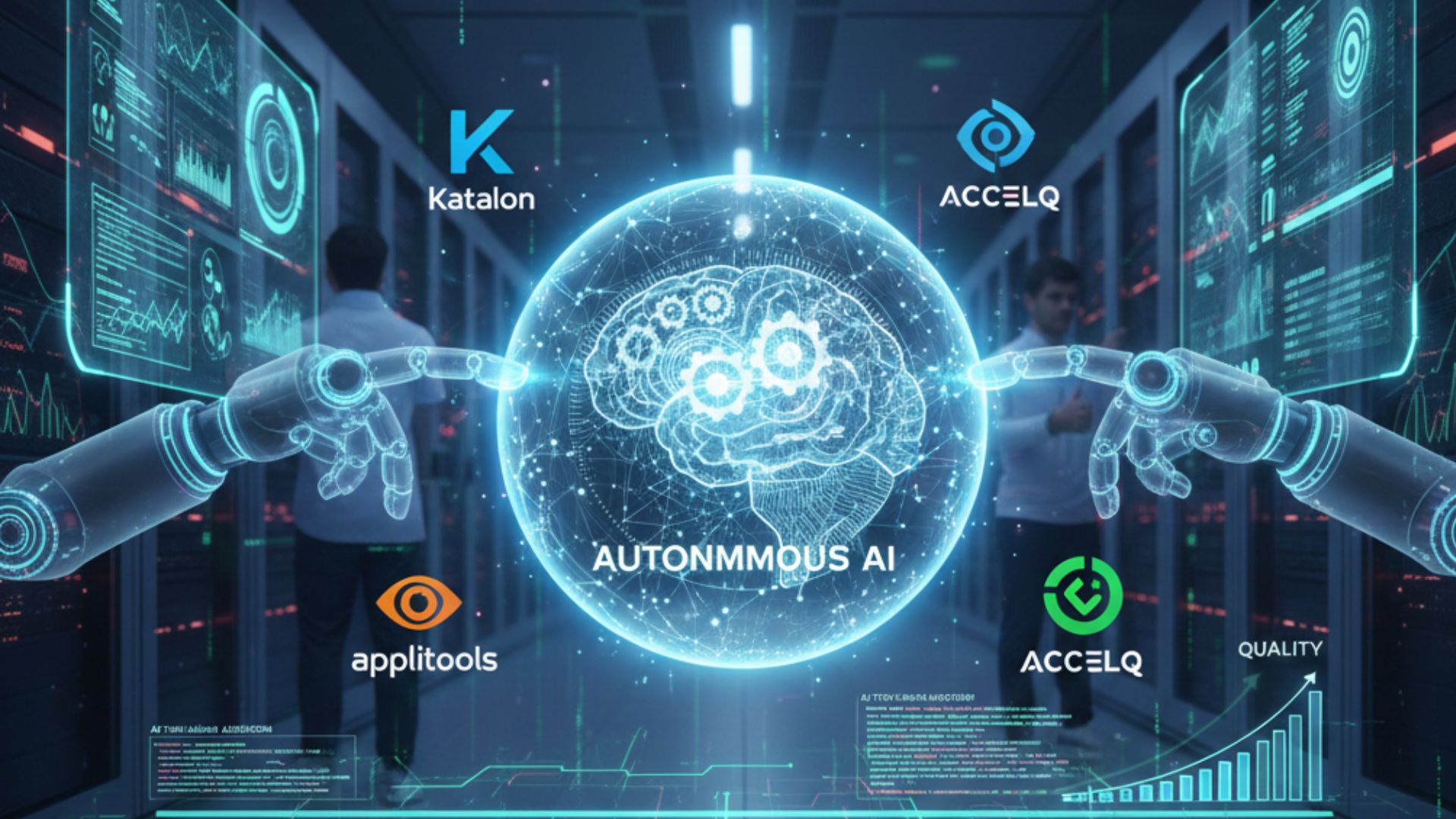
The old problems in QA—brittle test scripts, shifting environment configurations, and the large amount of test data to manage—are now being systematically tackled by advanced AI. Tools that were once just ideas, such as self-healing tests, AI-driven code generation from natural language, and visual AI that understands applications like humans, are now effective solutions. This detailed overview will look at how companies like Katalon, Applitools, and ACCELQ are leading this change, fundamentally transforming the role of the QA engineer and speeding up software delivery in an age marked by Generative AI and rapid development cycles.
- The Evolution of Test Automation: From Scripts to Sentience
To grasp the significance of 2026, we need to look back briefly.
The 2000s: Manual to Record/Playback: Early tools focused on recording user actions and replaying them. These were fragile and easily broken.
The 2010s: Script-Based Frameworks: Selenium and similar tools brought in robust automation through code. They required coding skills and had high maintenance needs.
Early 2020s: Intelligent Automation (The Promise): Frameworks introduced basic AI to identify elements, but true self-healing was still in its early stages.
2026: Autonomous Testing (The Reality): AI has advanced beyond just finding elements to understanding context, predictive maintenance, and proactive test creation. The main goal is to reduce human involvement in the testing process.
This shift isn’t just gradual; it’s rapid. The rise of advanced Large Language Models (LLMs), improved Computer Vision (CV), and distributed AI agents has laid the foundation for truly intelligent QA systems.
- The Pillars of Autonomous QA: Key AI Capabilities in 2026
The autonomous QA revolution rests on three intertwined technological pillars: AI-driven Self-Healing, AI Code Generation, and Visual AI.
2.1. AI-Driven Self-Healing: The End of Flaky Tests
This is perhaps the most impactful progress for everyday QA tasks. The annoyance of waking up to a failed test suite due to a minor change in a UI element ID is quickly becoming a thing of the past. In 2026, self-healing is not just a feature but an expectation for any test automation platform.
How it Works in 2026:
When a test script tries to find a UI element (like a button or text field) and its main identifier has changed, the AI agent doesn’t immediately fail the test. Instead, it starts a recovery process:
Contextual Search: The AI looks at the surrounding DOM elements, understanding the context of the missing element.
Visual Recognition (Computer Vision): Using advanced CV algorithms, the AI identifies the element visually. It can recognize a “Login” button based on its text, color, shape, and placement among other visual elements, even if the code has changed.
Weighted Attribute Matching: Instead of relying on one attribute, the AI creates a “fingerprint” of the element that includes various attributes (name, class, text, tag, past IDs). It then uses a weighting algorithm to find the best match.
Behavioral Inference: If the element is part of a known user interaction (like clicking a “Next” button), the AI can deduce its intended action and attempt to interact with a visually and functionally similar element.
Proactive Suggestion & Auto-Update: Once the AI successfully repairs the test, it doesn’t just continue. It learns from the change, logs it, suggests an update to the test script’s element locators, and can even, with approval, automatically update the object model in the repository. This means future runs will use the more reliable locator.
The Autonomous QA Revolution :AI Supremacy in Test Automation, 2026 Clean but Powerful
Leading the Charge in Self-Healing:
ACCELQ: Has led efforts in “Element Aging” and predictive self-healing. Their AI understands that UI elements change over time. Their platform monitors element history and anticipates changes, making scripts reliable even during major UI updates. ACCELQ’s patented Cloud-Native AI allows for continuous learning across many customer applications.
Katalon Studio: Incorporates Smart Locators powered by AI, which automatically find alternative elements and suggest updates, greatly lowering manual maintenance efforts. Their AI engine assesses over 10 properties of UI objects, providing a strong healing mechanism.
Impact:
Reduced Maintenance Overhead: Engineers spend less time fixing broken tests and more time on essential exploratory testing.
Increased Test Reliability: Test suites become more resilient to small UI changes, leading to greater confidence in test results.
Faster Feedback Cycles: Fewer false positives from broken tests provide development teams with clearer, more trustworthy signals regarding code quality.
2.2. AI Code Generation: From Natural Language to Test Code
The idea of “no-code” or “low-code” test automation has been present for some time, but AI Generative Models have greatly boosted this capability in 2026. Testers can now describe test scenarios in simple English, and the AI turns them into executable test scripts.Read more….
How it Works in 2026:
Natural Language Processing (NLP): Advanced LLMs analyze user input, grasping the intent, actions, and assertions. For instance, “Verify successful login with valid credentials” translates into steps: find username field, enter data, find password field, enter data, click login button, and check if the dashboard is visible.
Contextual Code Generation: The AI doesn’t generate generic code. It understands the specific application being tested by examining its DOM, existing object models, and past test data. It generates relevant code using the appropriate element locators, API endpoints, or mobile gestures.
Framework Agnostic Output: Modern tools can create code in various popular frameworks (Selenium, Playwright, Cypress, Appium, Karate API) or their proprietary formats, making them highly flexible.
Test Data Synthesis: Beyond code, AI can also create realistic and varied test data for different scenarios (e.g., generating 10 unique user profiles for a registration test). This addresses a significant hurdle in complex test scenarios.
Self-Correction & Learning: If an AI-generated script fails, the AI examines the failure logs, identifies the problem (like an incorrect locator or timing issue), and adjusts the script for future runs.
Leading the Charge in Code Generation:
Katalon’s AI Studio Assist: Has greatly improved. It works with major LLMs so users can describe a test case, and it produces the script within Katalon Studio. Beyond basic tasks, it can create complex API tests, data-driven tests, and handle conditional logic based on natural language input.
Emerging “Agentic Testing” Platforms: New companies are focused entirely on AI-driven test creation. Users simply provide the AI with a user story or a Figma design, and it independently designs and executes the test cases. This goes beyond simple code generation to actual test design.
Impact:
Democratization of Automation: Manual testers can directly contribute to automation without needing extensive coding knowledge.
Faster Test Creation: This significantly shortens the time from requirement to executable test.
Increased Test Coverage: Enables quick expansion of test suites, especially for new features or frequent releases.
“Living Documentation”: Test cases written in natural language act as clear, executable records of the application’s behavior.
2.3. Visual AI: Testing Beyond the DOM
Traditional automation, which relies on the Document Object Model (DOM), misses visual problems. A button may be present in the DOM but could be off-screen, overlapping with text, or the wrong color. Visual AI fills this gap by “seeing” the application as a human user would.
How it Works in 2026:
Intelligent Baselines: Visual AI captures a “baseline” image of the application’s UI. This baseline is then compared intelligently against subsequent test runs.
Perceptual Diffing: Instead of a strict pixel-by-pixel comparison (which is fragile), Visual AI uses advanced Computer Vision to identify perceptual differences. It can tell the difference between a harmless pixel shift and a real layout issue.
Root Cause Analysis: When a visual difference is spotted, the AI can often identify the exact DOM element responsible for the change, working with development tools for quick debugging.
Cross-Browser/Device Validation: This is where Visual AI excels. One visual test can confirm the UI’s consistency across hundreds of browser versions, operating systems, and device types at the same time, without needing separate tests for each.
Multi-Modal AI Integration: In 2026, Visual AI platforms like Applitools Eyes are combining with LLMs. They can not only spot a visual bug, but also assess its significance based on the context (e.g., a missing “Add to Cart” button on a shopping site is critical; a slightly misplaced footer element may be minor).
Leading the Charge in Visual AI:
Applitools Eyes: Continues to set the standard in Visual AI. Their Ultrafast Test Cloud enables testing across multiple environments at once, dramatically speeding up visual validation. Their “cognitive” approach ignores trivial changes (like font rendering differences) and focuses on user-visible issues.
Katalon Studio’s Visual Testing: Provides integrated visual validation functions, enabling teams to catch visual bugs along with functional defects in a single platform.
Impact:
Unprecedented UI/UX Quality: Detects visual issues that code-based tests cannot find.
Reduced Testing Time: Removes the need for extensive manual visual checks across many environments.
Improved User Experience: Ensures a consistent and visually appealing experience for end-users across all platforms.
“Pixel Perfect” Confidence: Provides strong assurance that the application looks exactly as intended.
- The Strategic Imperatives: AI’s Impact on the QA Ecosystem
The integration of AI is not only changing tools; it is reshaping teams, processes, and strategic goals.
3.1. Shifting Left: From Reactive to Proactive QA
AI enables earlier testing in the development process with “True Shift-Left.”
Requirements to Tests: AI can create test cases directly from user stories, design documents, or Figma prototypes.
Developer-Led Testing: With AI generating and fixing scripts, developers can run complete regression suites locally before committing code, catching bugs early. This lessens the load for dedicated QA teams.
3.2. The Evolving Role of the QA Engineer: From Scripter to Curator
The worry that “AI will take my job” is shifting to the truth that “AI will change my job.”
Focus on Strategy & Experience: QA engineers are now free from monotonous script maintenance to concentrate on higher-value tasks:
Designing complex test strategies.
Performing exploratory testing.
Analyzing user behavior for new test scenarios.
Curating and validating AI-generated tests and suggestions.
Evaluating overall user experience (UX) and performance.
AI Trainers & Auditors: A new role as “AI Test Agent Trainer” is emerging, where QA experts refine AI models for specific application domains or complex testing scenarios.
3.3. DevOps & Continuous Quality (CQ): A Unified Pipeline
AI-driven test automation is key for achieving true Continuous Quality in DevOps.
Faster CI/CD Pipelines: Autonomous tests run faster, repair themselves, and offer quick feedback, allowing for multiple daily deployments without sacrificing quality.
Predictive Quality: AI looks at historical data (code changes, test failures, production issues) to forecast areas of the application likely to fail, enabling targeted and proactive testing.
Auto-Remediation: In advanced setups, AI can not only detect issues but also suggest code fixes or even automatically roll back problematic deployments.
- The Future Outlook: Beyond 2026
Current advancements are just the beginning. The next three to five years will see AI’s role in QA grow deeper:
Self-Managing Test Environments: AI will dynamically set up, configure, and dismantle test environments on demand, ensuring complete isolation and reproducibility.
Autonomous Test Orchestration: AI will smartly determine which tests to run based on code changes, risk assessment, and past failure patterns, rather than just running everything.
True Production Monitoring Integration: Test automation will seamlessly merge with production visibility. If a bug is found in production, AI will automatically create a new regression test for it and add it to the test suite.
- Conclusion: Embracing the Autonomous QA Paradigm
AI in Test Automation in 2026 is no longer a futuristic idea; it is the current state of the art. Platforms like Katalon, Applitools, and ACCELQ are not just introducing new features; they are shaping a new approach for quality assurance. The transformation from manual to automated, and now to autonomous testing, is fundamentally changing the way software is created, tested, and delivered.